Executive Summary
Corporate gifting has shifted from only high-dollar gestures to frequent, thoughtful moments of recognition. Small gifts— those under $10—are emerging as one of the most effective tools for strengthening employee engagement and client loyalty.
A study from Sendoso (2025) found that companies using ongoing micro-gifting programs see 41% higher engagement and 28% better retention than those relying solely on annual or holiday gifts. Similarly, SHRM (2024) reports that 7 in 10 employees say small, spontaneous recognition moments make them feel more valued than a single large bonus.
Small gifts, when done with intention, are proof that appreciation doesn’t need to be extravagant to be effective.
This article explores:
The science behind small gifting and its emotional ROI
How under-$10 gestures build lasting connections
When to choose small vs. large gifting
Data-backed best practices
How Torn Ranch makes small gifts feel luxurious
1. Why Small Gifting Works
Modern corporate culture thrives on frequency and authenticity. While major gift baskets or towers are still appreciated, they are usually reserved for year-end or milestone events. The more powerful connection often happens through consistent, unexpected gestures—something small that says “you’re seen.”
70% of employees say that frequent, smaller gifts make them feel more appreciated than a single large one (SHRM 2025).
61% of managers now use on-the-spot gifting to celebrate key performance milestones or client wins (Gallup, 2024).
86% of HR departments plan to expand their “micro-recognition” budgets in 2025 (BusinessWire, 2024).
Why? Because small gifts are timely, personal, and easy to scale. A $9 truffle tin or a single-serve nut pouch can be handed out instantly—after a project close, positive client review, or monthly milestone—keeping gratitude continuous rather than episodic.
Summary: Small gifts succeed because they deliver appreciation at the right time, not just the right price point.
2. The Psychology Behind Micro-Gifting
Behavioral research shows that the frequency of recognition is more powerful than the size of a gift. According to a Cornell Hospitality Study (2024), when employees receive recognition within 24 hours of achievement, satisfaction increases by 37%, and repeat performance improves by 32%.
This is due to a psychological principle known as the “recency effect.” Positive reinforcement works best when the reward follows the behavior closely. The faster the recognition, the stronger the emotional link between effort and reward.
For clients, the same pattern holds true. Forrester Research (2025) found that clients who received small, personalized follow-up gifts after meetings were 18% more likely to renew contracts or make repeat purchases.
Summary: Small, well-timed gifts build emotional memory—making gratitude tangible and timely.
3. When to Gift Small vs. Large
Both small and large gifts have strategic roles. The key is knowing when to use each. Small gifts keep the relationship alive between major milestones; large gifts celebrate the milestone itself.
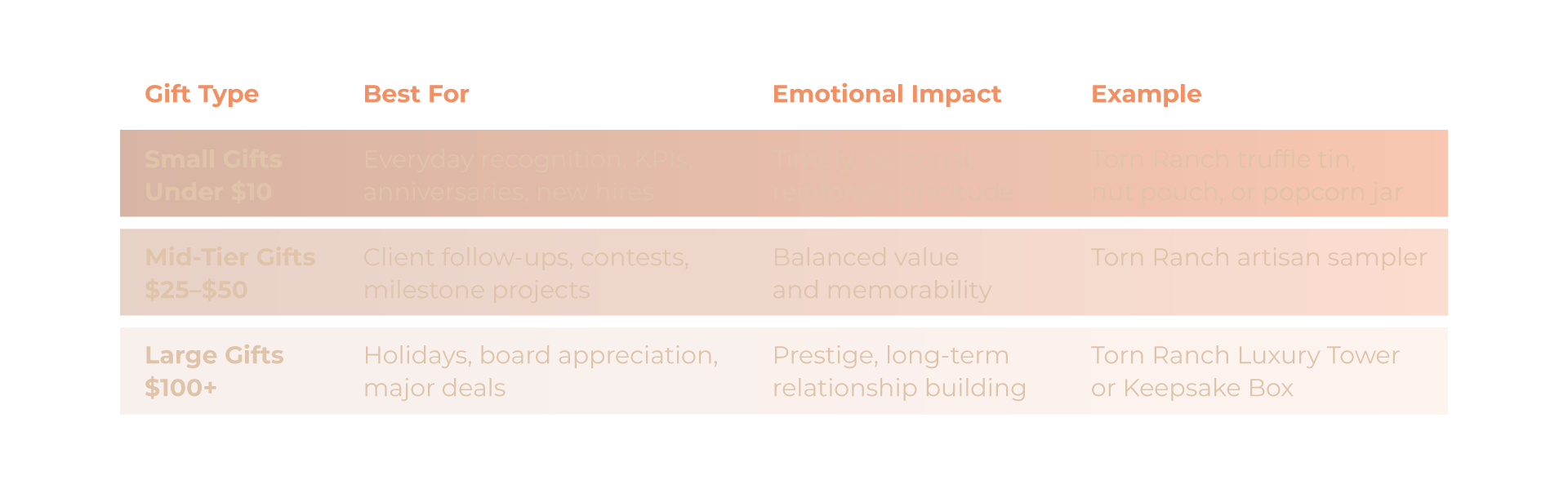
According to PPAI Research (2024), programs that combine both small and large gifting yield 22% higher loyalty scores than those relying on only one category.
Summary: Frequent small gifts maintain emotional connection; large gifts mark meaningful milestones. The best gifting strategies use both.
4. Measuring the ROI of Small Gifting
The power of small gifting lies in its scalability and visibility.
Employee Engagement: Teams receiving monthly or quarterly micro-gifts show 21% higher morale (Gallup, 2024).
Client Retention: Businesses that practice consistent appreciation increase repeat sales by 18% (Forrester, 2025).
Recruitment Advantage: Glassdoor (2024) found that 47% of job seekers are more likely to apply to companies known for employee recognition programs.
Small gifts are also cost-effective. Even a $500 annual micro-gifting budget per team can deliver thousands in goodwill value and retention savings.
Summary: Measured over time, small gifting delivers high emotional ROI for minimal investment.
5. Torn Ranch: Making Small Gifts Feel Luxurious
Torn Ranch proves that a small gift can still feel substantial. Every truffle, nut tin, and popcorn jar is handcrafted in California using premium ingredients and sustainable packaging—turning even a $9 gesture into a meaningful experience.
What Makes Torn Ranch Ideal for Small Gifting
Craftsmanship: Hand-roasted nuts, couverture chocolates, and small-batch caramel and toffee.
Sustainability: Compostable films, recyclable tins, and eco-conscious packaging that align with ESG goals.
Flexibility: Available in compact, gift-ready formats perfect for recognition programs, client follow-ups, or event giveaways.
Customization: Add hot stamps and thank-you cards for a personal touch.
For companies managing both small and large-scale gifting, Torn Ranch offers seamless program design—from under-$10 “thank yous” to premium executive towers.
Summary: Torn Ranch transforms everyday gestures into elegant brand expressions, proving that luxury doesn’t require scale—it requires care.

Conclusion
The most effective gifting strategies are not defined by budget, but by consistency, intention, and timing. Small gifts are the connective tissue between milestones—the everyday reminders that appreciation is part of a company’s culture, not an afterthought.
A $9 truffle box or nut tin, delivered thoughtfully, can strengthen loyalty, improve morale, and reinforce brand warmth far beyond its cost.
The secret is simple: Small gifts build relationships. Large gifts celebrate them. Torn Ranch helps you do both—beautifully.

Deana Morrow
CEO, Torn Ranch
Deana Morrow is the CEO of Torn Ranch, where she brings together her expertise in hospitality, food, and brand innovation to create memorable, purpose-driven experiences. She loves helping partners elevate their programs through thoughtful design, premium ingredients, and meaningful presentation.
INTERESTED IN WORKING WITH US?
Send us your details and we'll be happy to start a conversation with you!